Could full mouth rehabilitation be right for me?
Worn or broken teeth, multiple failing restorations, or uncomfortable chewing may warrant evaluation. Candidacy is determined after a clinical examination, not from symptoms or photographs alone.
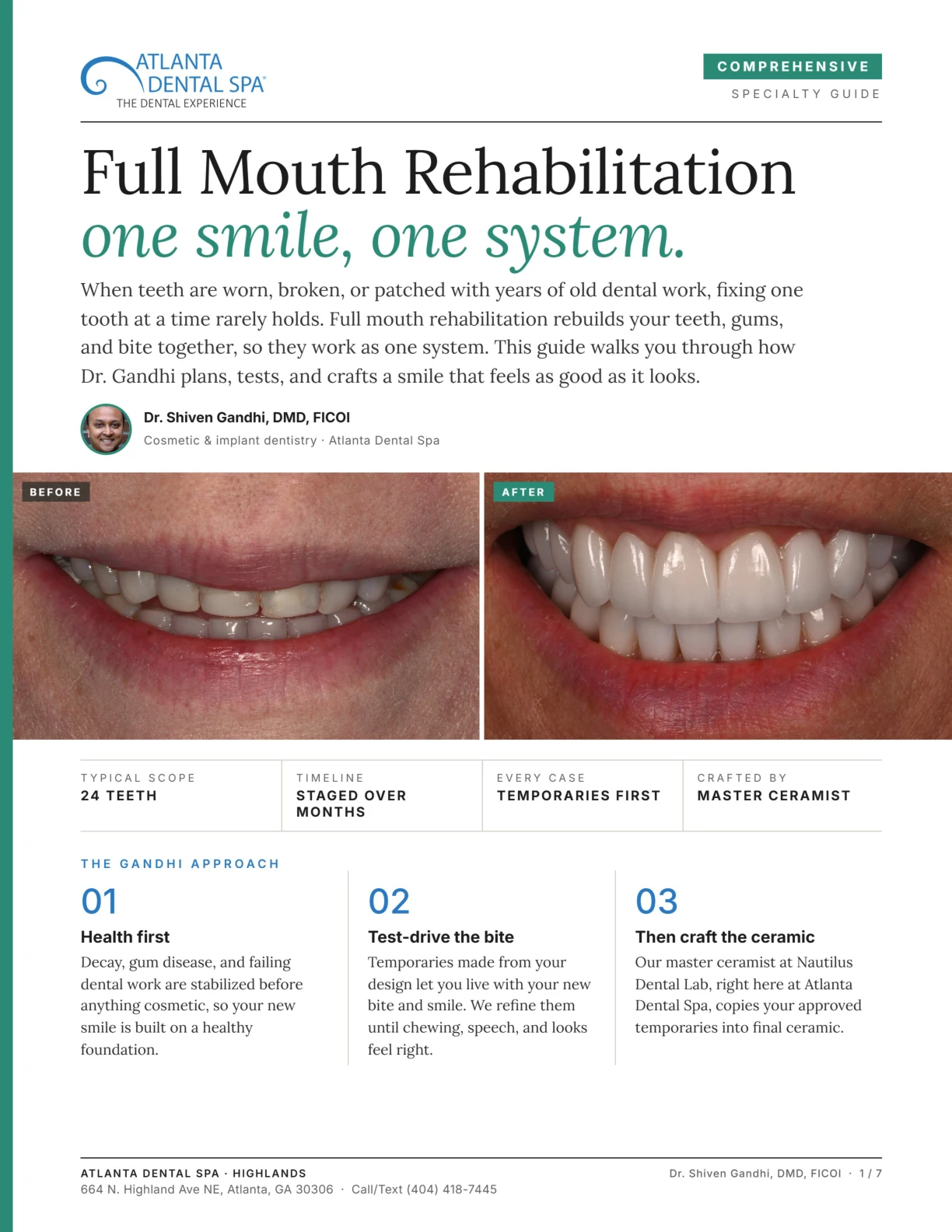
One smile, one system.
This is Dr. Shiven Gandhi’s complete, original 7-page guide, with all photographs, diagrams, and treatment details. For general education only; follow your provider’s individualized instructions. Results vary, and fees and timelines are confirmed during your visit.
Learn how Dr. Gandhi rebuilds worn teeth, gum health, and your bite together: detailed records, stabilization, a temporary-smile test-drive, master-ceramist ceramics, phased treatment, night-guard care, and investment.
Explore the illustrated guide above, switch to Text View for easier reading on a phone, or download your copy.
When teeth become worn, shortened, broken, or surrounded by years of failing restorations, the concern can reach beyond appearance. Chewing may feel uncomfortable, and your bite may no longer meet evenly. Full mouth rehabilitation considers the teeth, gums, bite, jaw joints, and muscles together rather than treating each tooth in isolation.
Dr. Gandhi’s approach begins with health, gives you time to live with a carefully designed new bite, and finishes with ceramic crafted from your approved temporaries. Your smile’s length, shape, and character matter, but so does how it feels in everyday life.
Grinding, clenching, acid exposure, and an uneven bite can contribute to short, flat, or chipped teeth. Old fillings and crowns may also leak or break down. Jaw fatigue, tightness, headaches, and difficulty chewing are reasons to seek an examination, not a diagnosis or proof that reconstruction is needed.
Care starts by stabilizing decay, gum disease, and failing dental work. Depending on your needs, the plan may combine crowns, veneers, implants for missing teeth, and gum therapy. Lost tooth height is restored carefully, with attention to your joints and muscles; changing the bite is not a guaranteed cure for TMJ symptoms or headaches.
You can begin with an optional virtual consultation using smile photos and a description of your goals. An in-office evaluation is needed to plan treatment, including an exam, digital imaging, photographs, scans, and a full bite analysis. These records inform your design and wax-up. At case review, Dr. Gandhi explains the design, sequence, and timeline, making room for your comfort and questions before treatment begins.
The guide describes six stages: records, case review, stabilization, provisionals, restorative treatment, and final delivery. These are not a promise of exactly six appointments. Treatment is individualized over several months. A typical 24-tooth plan extends first molar to first molar in both arches; optional second molars may follow a few months later, bringing the scope to 28 teeth.
Your temporaries are a working prototype, not simply placeholders. Made from your design and wax-up, they restore tooth length and establish the proposed bite. Daily chewing, speech, and smiling help you evaluate comfort, shape, and esthetics. Your feedback guides adjustments as Dr. Gandhi watches how your teeth, jaw joints, and muscles respond.
This is deliberately the longest phase: time to test, refine, and approve rather than rush into permanent ceramic. When needed, a second, stronger set of laboratory-made PMMA temporaries helps confirm tooth positions, bite contacts, and shapes, while giving you more practice with the new bite. One additional PMMA set is included in the rehabilitation fee.
At Nautilus Dental Lab, on-site at Atlanta Dental Spa, the master ceramist copies your approved temporaries into final ceramic. This close connection carries the tested length, contours, and bite from Dr. Gandhi’s chair to the laboratory. Definitive restorations are fitted in stages, with implant treatment incorporated where appropriate to your individual plan.
Final delivery includes checking the fit, fine-tuning and polishing the bite, and making your night guard or retainers. The guide’s patient gallery includes 28-unit ceramic reconstructions and a case involving implants. These photographs illustrate individual treatment plans, not a standard prescription or a promise of the same result for everyone.
Bring a complete medication and medical-condition list, complete any recommended specialist consultations, and allow a flexible schedule for multiple visits. Arrange a driver for sedation or surgical days. Follow the team’s own written preparation and recovery instructions for your procedure rather than treating this overview as personal medical guidance.
Adjusting to a new bite can take days to weeks, and some jaw or gum soreness is possible. Avoid hard, sticky foods while wearing temporaries. Contact the team about high spots or concerns so adjustments can be made. After ceramic delivery, wear your night guard every night to protect your reconstructed teeth.
Worn or broken teeth, multiple failing restorations, or uncomfortable chewing may warrant evaluation. Candidacy is determined after a clinical examination, not from symptoms or photographs alone.
The focus extends beyond appearance to comprehensive reconstruction: gum health, tooth height, bite contacts, joints, and muscles are considered alongside the smile’s design.
No. Twenty-four teeth is the guide’s typical first-molar-to-first-molar scope. Second molars can bring a plan to 28, but your examination determines your treatment needs.
The six stages unfold over several months, with provisionals usually taking longest. Stabilization, adjustments, and any implant treatment shape an individualized schedule, not a fixed appointment count.
Stronger lab-made PMMA temporaries provide further testing of positions, bite, and shape before ceramic. They are used when needed; one additional set is included.
The on-site master ceramist at Nautilus Dental Lab crafts the final ceramic from your approved temporaries. Crowns, veneers, and implant restorations are planned as appropriate.
Adaptation can take days to weeks. Report high spots, soreness, or concerns to the team. Provisionals allow refinement before ceramic; symptom relief is not guaranteed.
No. Optional IV conscious sedation costs $850 per sedation appointment, with health-history review, pre-sedation evaluation, and continuous monitoring. A responsible adult must drive you home; follow your written instructions.
The fee is $2,600 per tooth: $62,400 for 24 or $72,800 for 28. Included are the exam, imaging, photos, scans, bite analysis, design and wax-up, design-guided preparation, initial temporaries, bite and shape adjustments, one additional PMMA set if needed, final ceramic, bite refinement and polishing, and a night guard or retainers. Optional sedation is extra. Your written financial agreement confirms your scope, sedation appointments, any separate implant or surgical charges, and the total before you begin.
Avoid hard, sticky foods with temporaries, report high spots promptly, and follow your personal care instructions. Wear your night guard every night after ceramic delivery.
Meet with Dr. Gandhi to review your goals, discuss your options, and confirm a treatment plan.
Educational information from Dr. Gandhi’s Full Mouth Rehabilitation Guide. Suitability and results vary. Your examination, written treatment and financial agreements, and personal care instructions take precedence. This overview is adapted from Dr. Gandhi’s specialty guide above. It is general education, not a diagnosis or personalized medical advice. Individual results vary; follow your provider’s written instructions.
Complete original guide. Use + to enlarge, then swipe or scroll sideways. Choose Text View for easier reading.