Can my implant be placed when the tooth is removed?
Sometimes. Bone condition, infection, and initial stability determine whether immediate placement or a grafted path is appropriate.
Rebuilt from the root.
This is Dr. Shiven Gandhi’s complete, original 6-page guide, with all photographs, diagrams, and treatment details. For general education only; follow your provider’s individualized instructions. Results vary, and fees and timelines are confirmed during your visit.
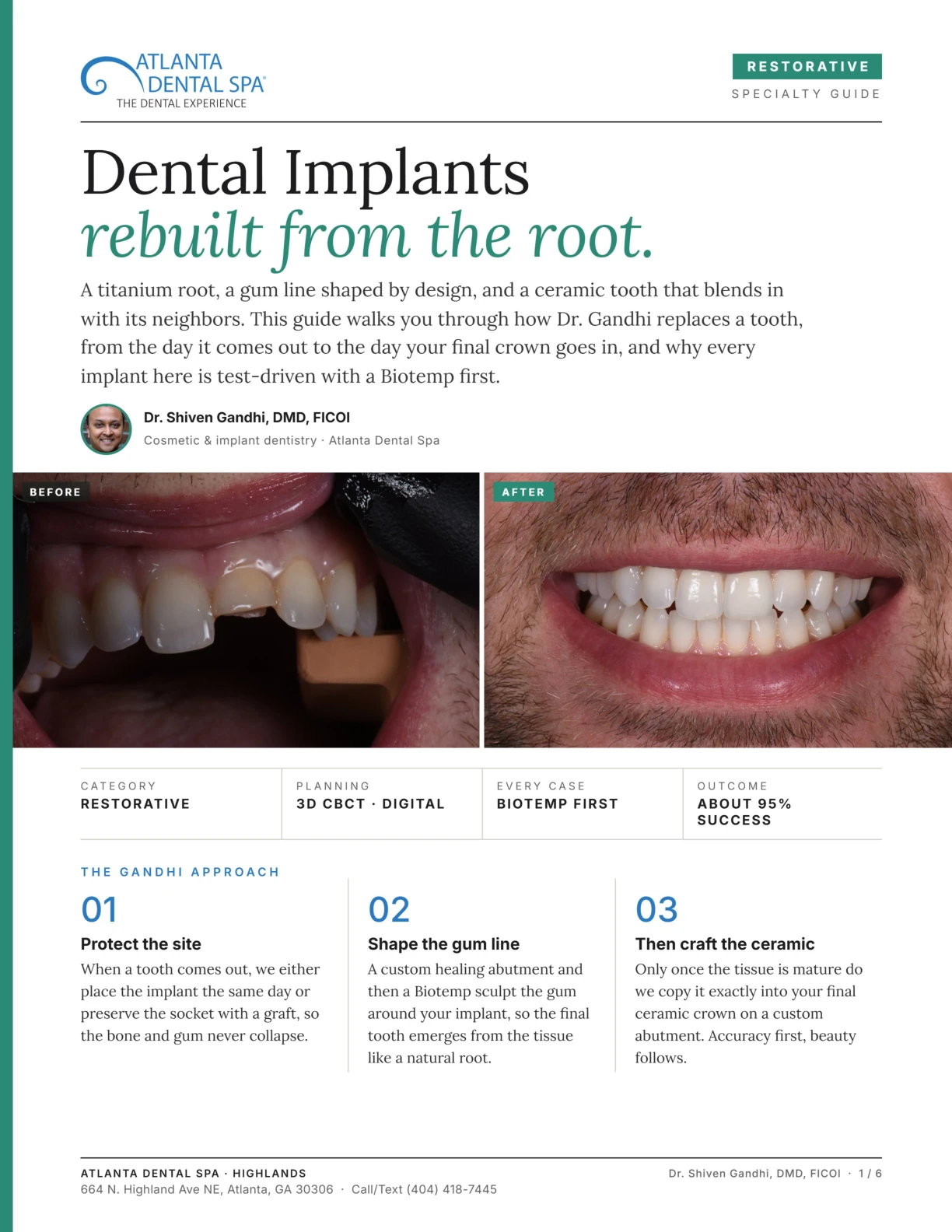
Explore Dr. Gandhi’s approach to replacing a tooth: immediate implants or socket preservation, 3D planning, custom gum shaping, a Biotemp test-drive, your final ceramic crown, and treatment timelines and investment.
Explore the illustrated guide above, switch to Text View for easier reading on a phone, or download your copy.
Replacing one tooth involves more than selecting a crown. The guide describes a titanium implant in the jawbone, tissue shaping around it, and a final ceramic tooth on a custom abutment. Planning considers the bone, gum line, infection status, and forces from your bite.
This guide covers single-tooth replacement, not full-arch treatment. Dr. Gandhi uses a consultation, photographs, a 3D CBCT scan, and digital planning to choose the sequence. A Biotemp provisional crown allows shape and bite evaluation before the final ceramic is made.
An immediate implant places the implant at the extraction visit. The guide describes this path when the surrounding bone walls are intact, there is no active infection, and the implant can achieve firm initial stability. A custom healing abutment supports the gum contour, with grafting where needed.
Socket preservation removes the tooth and protects the socket with a bone graft and membrane before implant placement. Infection, damaged bone walls, or a need for more bone may favor this staged approach. This staged approach supports the foundation while the site heals.
Dr. Gandhi’s guide gives typical overall timelines of five to six months for an immediate implant and eight to nine months for socket preservation plus an implant. The grafted path includes about three to four months of bone maturation before implant placement.
The immediate workflow typically involves eight visits: consultation, surgery, healing check, integration assessment, Biotemp scan, Biotemp fit, evaluation, and final crown. Socket preservation adds preliminary stages. Stability is checked before loading the implant; your personal plan confirms the timing.
The Biotemp is a custom provisional crown screwed onto the implant. Its contours are adjusted while the gum matures around it. Shape, length, and bite can be evaluated in the mouth, and the approved tissue profile is captured for the final restoration.
A custom abutment supports that developed gum profile. The guide describes a screw-access ceramic crown, with cementation completed in the laboratory outside the mouth. Screw access allows removal for care or repair when needed.
Follow your provider’s individual preparation and recovery instructions, including any sedation arrangements. The guide discusses a soft diet and protecting the surgical site during healing. Contact the practice immediately for severe pain, swelling, bleeding, or fever.
Maintenance remains part of the conversation after the final crown. Ask about cleaning around your restoration, follow-up visits, and how to report changes in comfort or bite. The guide describes access for care and repair but does not provide a fixed long-term maintenance schedule.
Sometimes. Bone condition, infection, and initial stability determine whether immediate placement or a grafted path is appropriate.
The guide offers optional Essix retainers, removable flippers, or Maryland bridges. These are separate from the later Biotemp phase and cost extra.
The Biotemp lets the team evaluate shape, bite, and gum development before making the final ceramic restoration.
Dr. Gandhi’s guide lists $7,002–$8,102 for immediate treatment and $7,452–$8,102 for socket preservation plus an implant. Both exclude an optional temporary tooth and sedation. Confirm your personal written quote.
No. Eight visits describes the typical immediate workflow; healing and additional grafting stages can change your schedule.
Use the instructions supplied by your provider for your procedure. This overview does not replace your personal surgical or sedation guidance.
Meet with Dr. Gandhi to review your goals, discuss your options, and confirm a treatment plan.
Educational information from Dr. Gandhi’s Dental Implant Specialty Guide. Timelines, fees, and outcomes vary; no individual result is guaranteed. Your examination, written treatment plan, and provider instructions take precedence. This overview is adapted from Dr. Gandhi’s specialty guide above. It is general education, not a diagnosis or personalized medical advice. Individual results vary; follow your provider’s written instructions.
Complete original guide. Use + to enlarge, then swipe or scroll sideways. Choose Text View for easier reading.